> For the complete documentation index, see [llms.txt](https://help.tellius.com/llms.txt). Markdown versions of documentation pages are available by appending `.md` to page URLs; this page is available as [Markdown](https://help.tellius.com/6.0/vizpads-explore/applying-global-filters.md).
# Applying global filters
Learn how to apply Tellius global filters across Vizpad tabs for consistent data context. Configure date, measure, and dimension filters to align charts accurately.
Global filters apply consistent filtering across all tabs within a Vizpad. Any filter configured at the global level cascades to every chart and tab in the Vizpad, ensuring uniform data context across the entire dashboard.
1. In a Vizpad, click on the **Add Filter** button and the following menu will be displayed.
2. Click on the **Applied to** option to determine the charts for which you will apply the filter.
2. If you want to apply a global filter (for all charts in all tabs), then select **All charts in the Vizpad**. All subsequent filter configurations apply to every Vizpad tab.
3. If you want to apply filters all the charts in the current tab, then select All charts in the tab.
4. If you want to apply the filters only to specific charts, then select **Selected Charts in this tab**.
{% hint style="info" %}
Once you set up the filter to be applied, then the following panel appears along with checkboxes for each chart/table in the current tab.
You can select the required charts and the count will be increased accordingly in the panel. **Select all** selects all the visuals in the tab, and the filter will be applied to the selected charts once you click on **Apply**.
{% endhint %}
5. If you want to apply filters to any date columns, then enable the Date filter toggle.
{% hint style="danger" %}
When **Date filter** toggle is disabled, only measures and dimensions will be displayed in the **Select Column** dropdown. If it is enabled, then only date columns will be displayed in the **Select Column** dropdown.
{% endhint %}
6. Once **All charts in the Vizpad** is selected, then the minimum and maximum range will be auto-selected. However, it overrides manual range modification so you can make necessary changes as required.
7. The auto-range will be selected as follows:
1. **Measures**: Selects the minimum and maximum values of the measure.
2. **Dimensions**: Defaults to `IN` (inclusion) operator.
3. **Date columns:** Calculates `MIN(date_column)` to `MAX(date_column)` from entire dataset.
8. Enable the **Use Alignment Mapping** toggle if you want to refer only the mapped measures. This will be displayed only if **Date filter** is enabled.
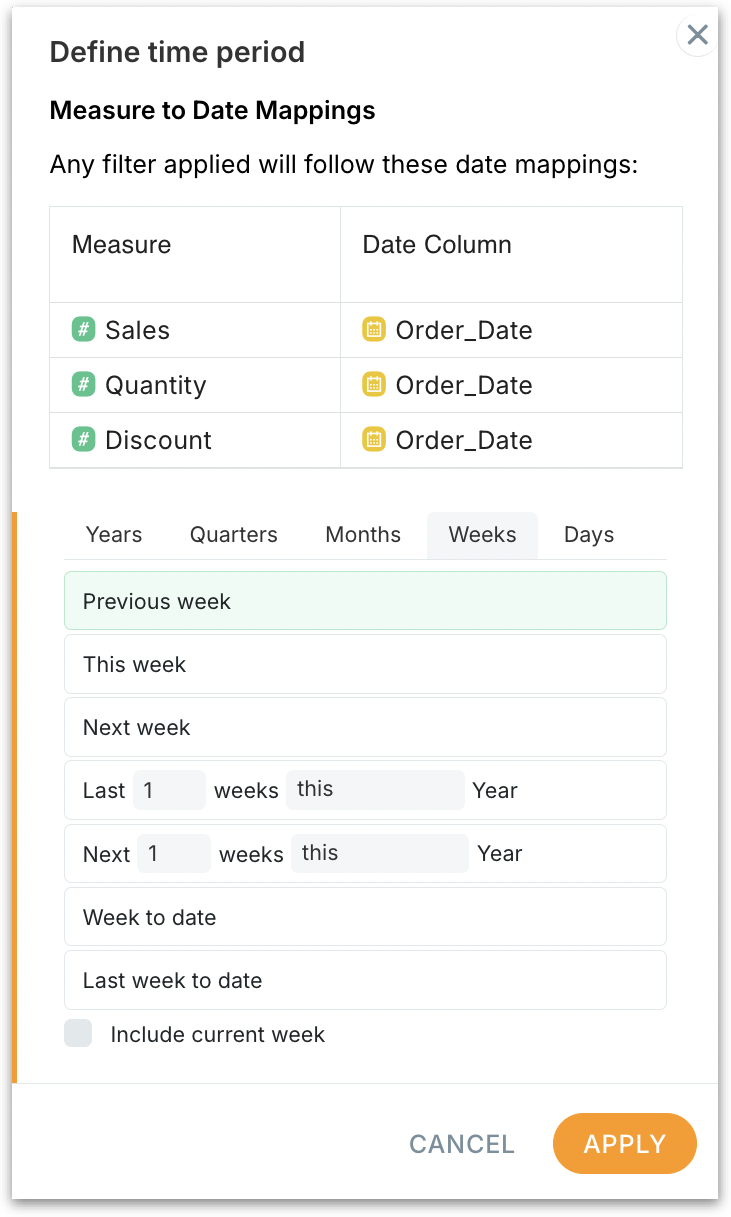
9. Click on the **Select time period** field and the following window will be displayed. The available **Measure → Date** mappings for the Business View will be listed.
10. Choose the required time range from the available list.
11. Click on **Apply** to save the changes. The date filter will be applied to the selected chart(s).
{% hint style="warning" %}
To set up new **Measure → Date** mapping(s) or to edit the existing mappings, please check out this [page](/6.0/data/preparing-your-business-views/mapping-measures-to-date-columns.md).
{% endhint %}
{% hint style="success" %}
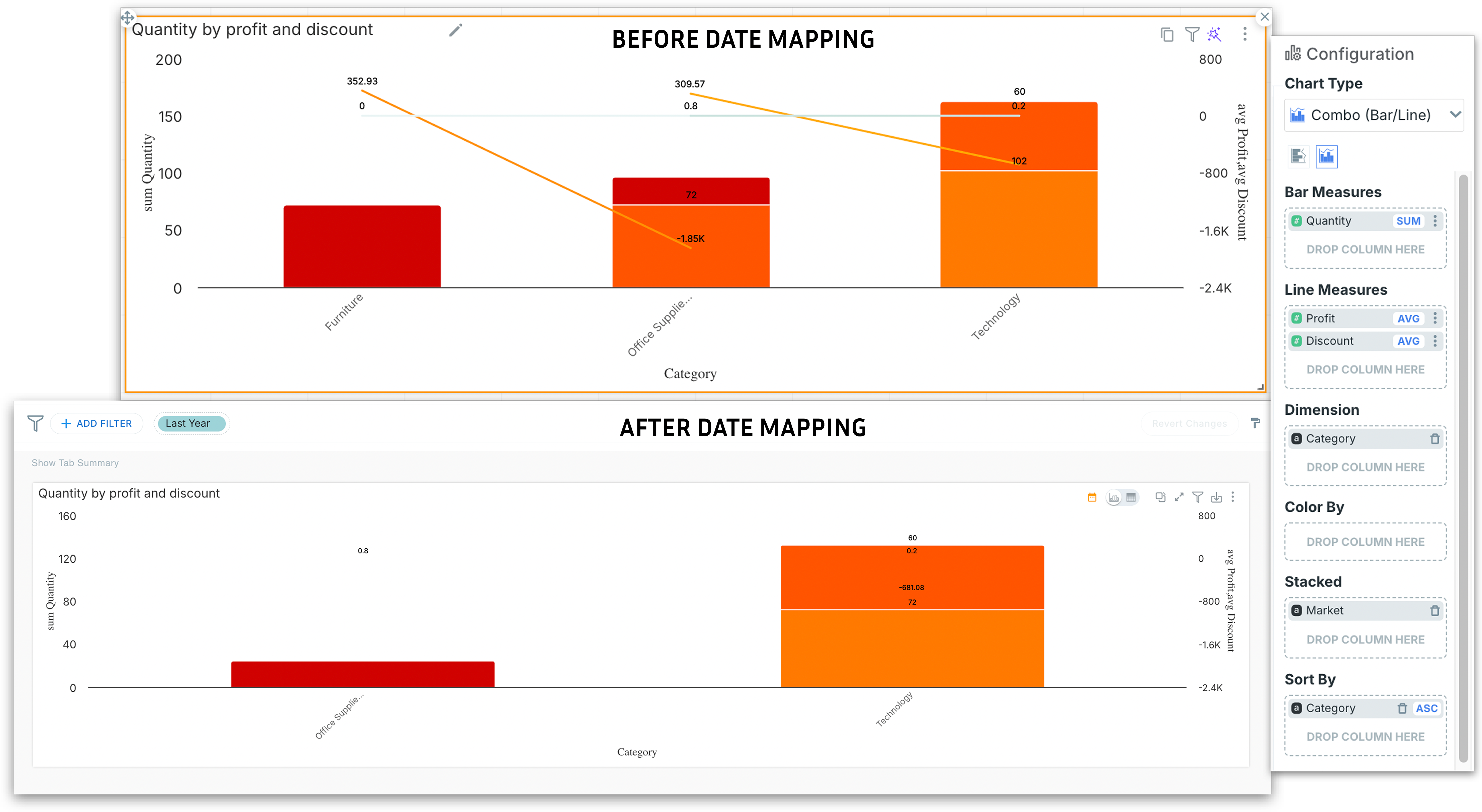
Because you mapped **Sales, Quantity, Discount → Order\_Date** and chose **Last year** with **Date mapping** enabled, Tellius first kept only the rows whose **Order\_Date** fell in last year. Then it aggregated by **Category**.
\
Without mapping, the time filter could have hit a different date column or been applied across measures. Mapping forces the filter to use the correct date per metric, so your bars and lines are apples-to-apples for “last year.”
{% endhint %}
---
# Agent Instructions
This documentation is published with GitBook. GitBook is the documentation platform designed so that both humans and AI agents can read, navigate, and reason over technical content effectively. Learn more at gitbook.com.
## Querying This Documentation
If you need additional information that is not directly available in this page, you can query the documentation by asking a question.
Perform an HTTP GET request on the following URL with the `ask` and `goal` query parameters:
```
GET https://help.tellius.com/6.0/vizpads-explore/applying-global-filters.md?ask=&goal=
```
`ask` is the immediate question: it should be specific, self-contained, and written in natural language.
`goal` is what the user is ultimately trying to achieve, the reason they need the answer. Sharing it helps GitBook give you a better, more relevant answer. A goal is most helpful when it describes the outcome the user wants rather than restating the question. For example, with `ask=how do I create an API token`, a goal like `automate deployments from our CI pipeline` lets GitBook tailor the answer to that use case.
The response will contain a direct answer to the question and relevant excerpts and sources from the documentation.
Use this mechanism when the answer is not explicitly present in the current page, you need clarification or additional context, or you want to retrieve related documentation sections.