> For the complete documentation index, see [llms.txt](https://help.tellius.com/llms.txt). Markdown versions of documentation pages are available by appending `.md` to page URLs; this page is available as [Markdown](https://help.tellius.com/6.0/vizpads-explore/control-filters/dropdown-list.md).
# Dropdown list
Learn how to create and configure a dropdown list control filter in Tellius. Explore selection options, include/exclude lists, and apply filters across Vizpads.
They act similar to multi-select lists but require less space than multi-select lists.
### Creating a dropdown list
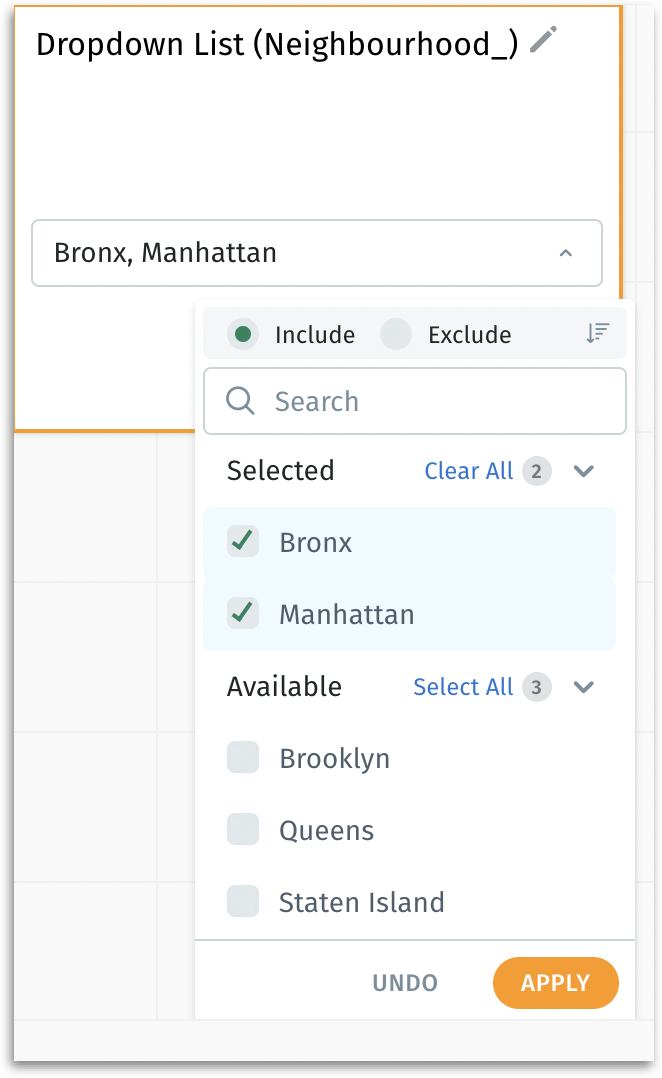
1. When you create a dropdown list, then a control filter widget named "***Dropdown List (chosen\_column)***" with a dropdown menu will be created.
2. Click on the dropdown menu to view the two nested lists **Include** and **Exclude,** and two collapsible lists **Selected** and **Available**.
Dropdown list
3. From the required Business View, select the dimension for which you want to apply filters.
4. Initially, there won't be any values under **Selected,** and all the values will be present under **Available** list.
5. Click on the pencil icon to rename the multi-select control filter.
6. To sort the filter values, click on the sorting icon to sort the values in ascending or descending order.
7. To search for a specific value, start typing the value in the search bar provided above **Selected**. The values matching your input will be displayed.
{% hint style="info" %}
**Available** list will display the first 300 values. Further scrolling will display the remaining values.
{% endhint %}
### Selecting the values
1. Once the user selects the required values, those values will be moved from **Available** to **Selected**.
2. **Include** list displays the list of included values. In that case, the values under **Selected** are the ones that will be considered for filters.
3. **Exclude** list displays the list of excluded values. In that case, the values under **Selected** are the ones that will not be considered for filters.
4. By default, **Include** list will be selected.
{% hint style="info" %}
If you have 200 values and want to select 5 of them, choose **Include** list.\
If you have 200 values but want to select 150 of them, choose **Exclude** list.
{% endhint %}
5. Click on **Clear All** next to **Selected** to unselect all the selected values. The number next to **Clear All** indicates the number of values selected.
6. Click on **Select All** next to **Available** to select all the values available in the column. The number next to **Select All** indicates the number of available values.
{% hint style="info" %}
No filter will be applied if all existing values are moved to the **Selected** list (in case of either **Include** or **Exclude**).
{% endhint %}
7. Once all the required values are selected, click on **Apply** to apply the filter or click on **Undo** to revert to the previously saved state.
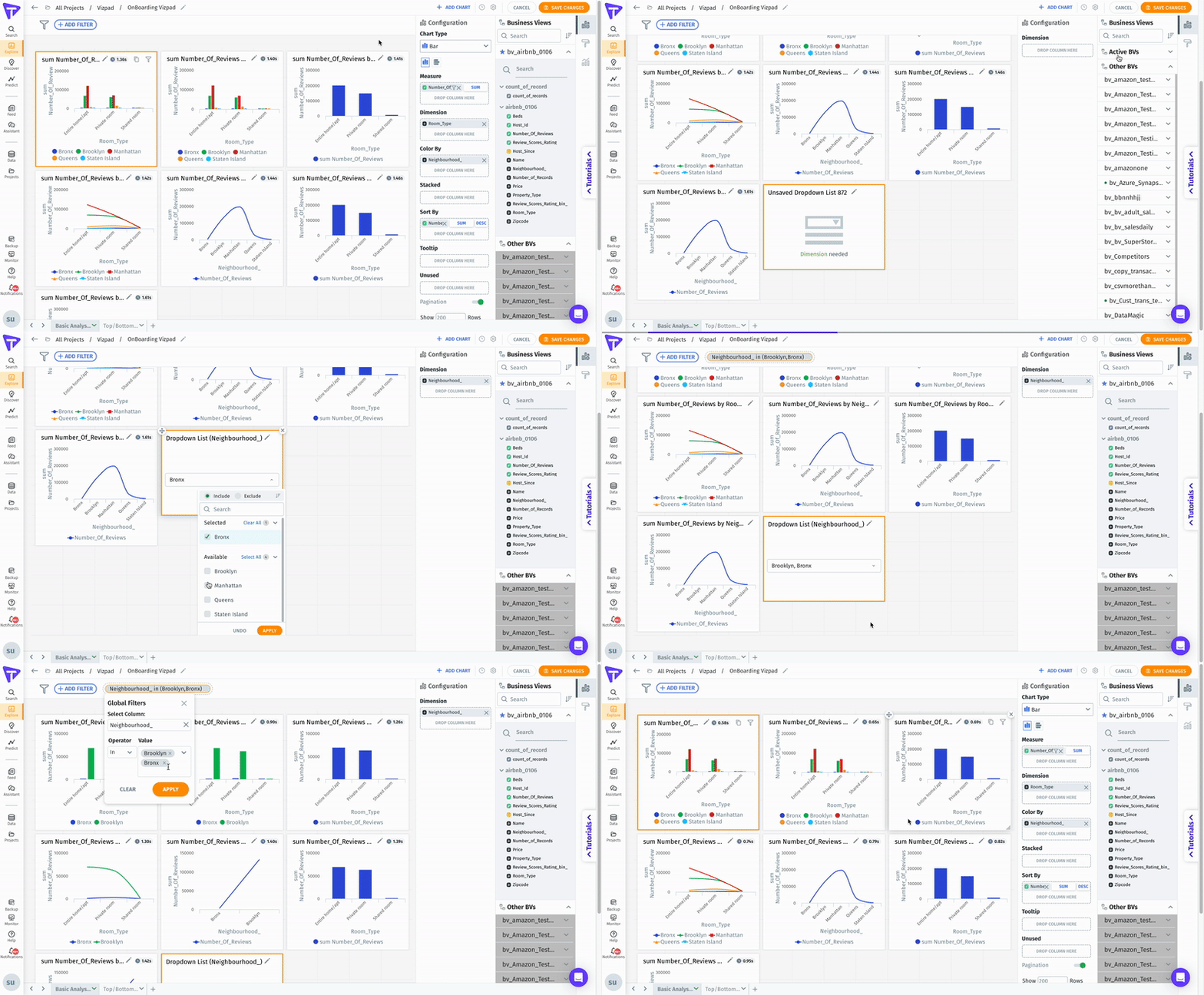
8. The filters will be applied to all the charts in the Vizpad that were created using the specific Business View, and a global filter pill will be created that reflects the applied control filter.
Dropdown list
---
# Agent Instructions
This documentation is published with GitBook. GitBook is the documentation platform designed so that both humans and AI agents can read, navigate, and reason over technical content effectively. Learn more at gitbook.com.
## Querying This Documentation
If you need additional information that is not directly available in this page, you can query the documentation by asking a question.
Perform an HTTP GET request on the following URL with the `ask` and `goal` query parameters:
```
GET https://help.tellius.com/6.0/vizpads-explore/control-filters/dropdown-list.md?ask=&goal=
```
`ask` is the immediate question: it should be specific, self-contained, and written in natural language.
`goal` is what the user is ultimately trying to achieve, the reason they need the answer. Sharing it helps GitBook give you a better, more relevant answer. A goal is most helpful when it describes the outcome the user wants rather than restating the question. For example, with `ask=how do I create an API token`, a goal like `automate deployments from our CI pipeline` lets GitBook tailor the answer to that use case.
The response will contain a direct answer to the question and relevant excerpts and sources from the documentation.
Use this mechanism when the answer is not explicitly present in the current page, you need clarification or additional context, or you want to retrieve related documentation sections.