> For the complete documentation index, see [llms.txt](https://help.tellius.com/llms.txt). Markdown versions of documentation pages are available by appending `.md` to page URLs; this page is available as [Markdown](https://help.tellius.com/tellius-6.3/embedding-tellius/embedding-url/embedding-assistant.md).
# Embedding Assistant
Embed Tellius Assistant into your application using iFrame and postMessage API—choose between full interface or conversation-only modes for interactive analytics.
Tellius Assistant can be embedded into external applications via iFrame using two available modes:
* **Full Assistant interface** – includes both the conversation panel and completely interactive charts where you can perform drill, filter, hover, and click operations real-time (same as within Tellius).
* **Conversation panel only** – shows just the answers with chart snapshots (non-interactive).
Embed URL from Settings
### **Steps to obtain the Embed URL**
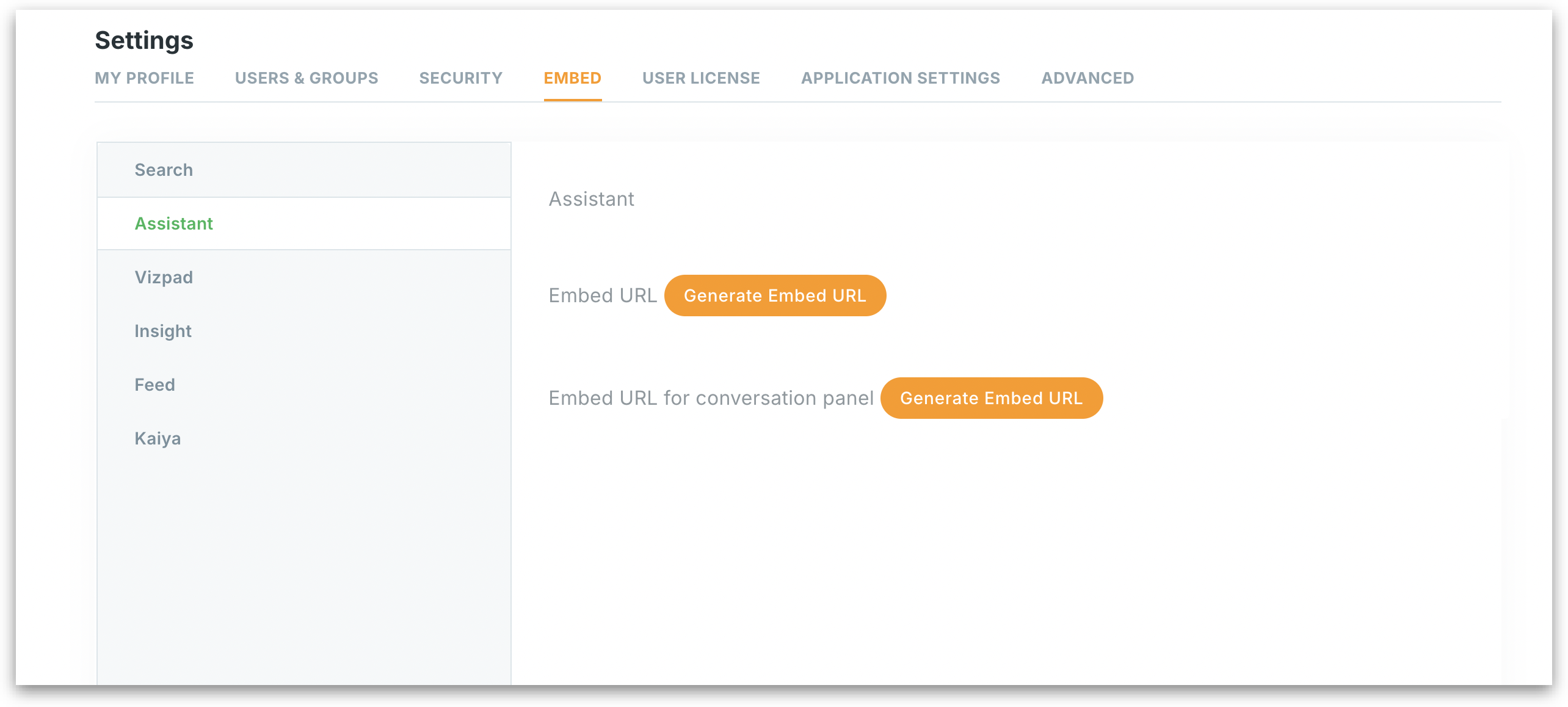
1. Under **Settings → Embed → Assistant**, you can chose from the type of embedding you want (interative vs non-interactive Assistant).
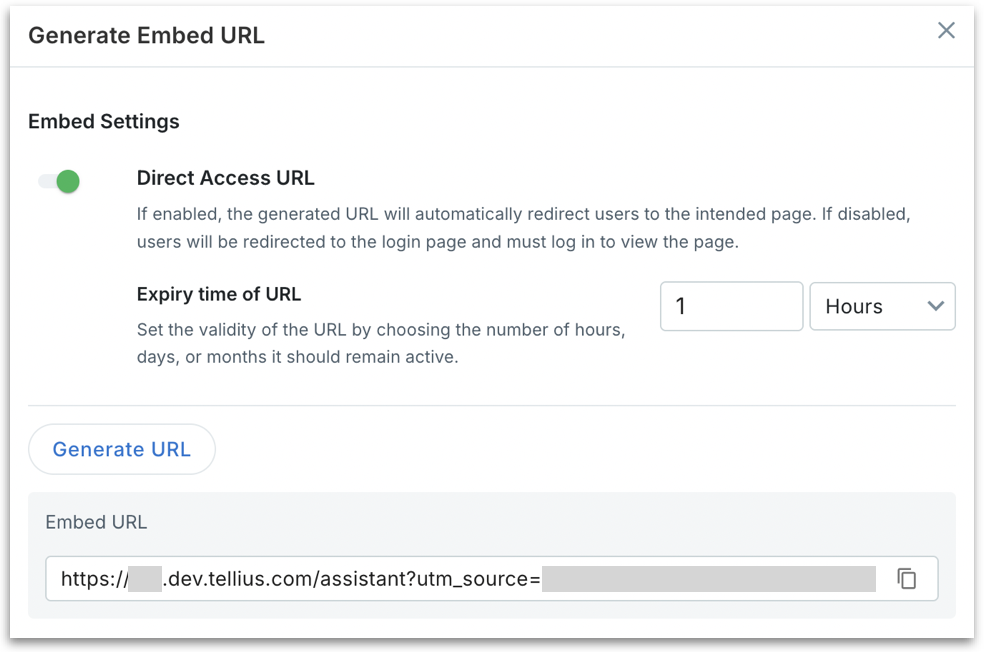
2. Once you click on **Generate Embed URL**, the following window will be displayed.
Generate embed URL
3. **Direct Access URL (toggle):** When enabled, users accessing the embedded URL are taken directly to the embedded Assistant interface (no login prompt). This only works when the token (passed via `utm_source`) has valid session context. When disabled, users will be redirected to the Tellius login screen before reaching the embedded component. Use this when you want user-level authentication to be enforced on access.
4. **Expiry Time of URL:** Controls how long the generated embedding URL remains valid. Specify the duration in hours, days, or months. After the set time, the token (`utm_source` or similar context ID) expires, and the link becomes invalid.
5. Once you click on **Generate URL**, the Embed URL will be generated.
6. Click on the **Copy** icon to copy the URL.
7. An embedding URL looks like the following: `https://domain/assistant?utm_source=ID`
8. Once you embed the URL, the **Assistant** page will be loaded.
---
# Agent Instructions
This documentation is published with GitBook. GitBook is the documentation platform designed so that both humans and AI agents can read, navigate, and reason over technical content effectively. Learn more at gitbook.com.
## Querying This Documentation
If you need additional information that is not directly available in this page, you can query the documentation by asking a question.
Perform an HTTP GET request on the following URL with the `ask` and `goal` query parameters:
```
GET https://help.tellius.com/tellius-6.3/embedding-tellius/embedding-url/embedding-assistant.md?ask=&goal=
```
`ask` is the immediate question: it should be specific, self-contained, and written in natural language.
`goal` is what the user is ultimately trying to achieve, the reason they need the answer. Sharing it helps GitBook give you a better, more relevant answer. A goal is most helpful when it describes the outcome the user wants rather than restating the question. For example, with `ask=how do I create an API token`, a goal like `automate deployments from our CI pipeline` lets GitBook tailor the answer to that use case.
The response will contain a direct answer to the question and relevant excerpts and sources from the documentation.
Use this mechanism when the answer is not explicitly present in the current page, you need clarification or additional context, or you want to retrieve related documentation sections.