> For the complete documentation index, see [llms.txt](https://help.tellius.com/llms.txt). Markdown versions of documentation pages are available by appending `.md` to page URLs; this page is available as [Markdown](https://help.tellius.com/tellius-6.3/kaiya/ask-across-your-documents-unstructured/how-to-connect-to-unstructured-data/connect-to-google-drive.md).
# Connect to Google Drive
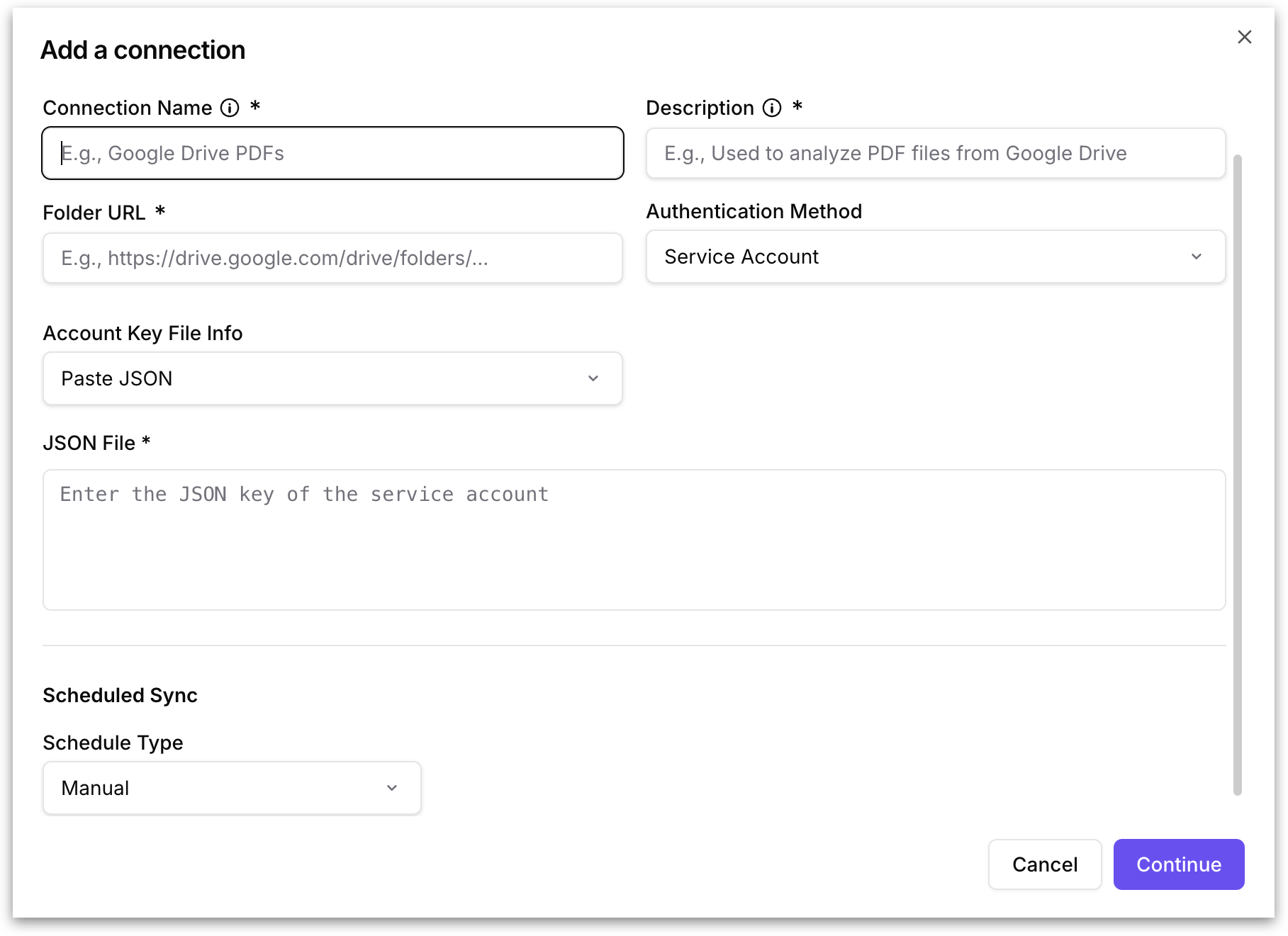
Clicking **Google Drive** opens the **"Add a connection"** dialog with the following fields.
**Connection Name:** A user-defined display name for this connection.
**Description:** A brief text description of the purpose of this connection.
**Folder URL:** The full URL of the Google Drive folder you want Tellius to connect to. This must be a direct link to a Google Drive folder in the format `https://drive.google.com/drive/folders/...`. Tellius will ingest all supported files within this folder.
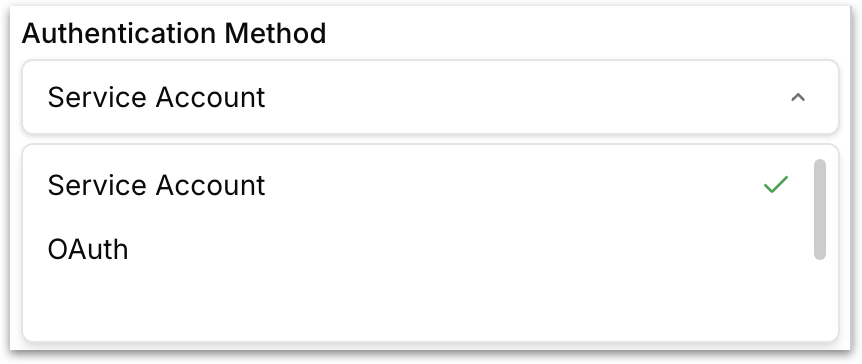
**Authentication Method:** A dropdown that specifies how Tellius authenticates with Google Drive.
* **Service Account -** Tellius uses a Google Cloud service account to access the folder. The service account must have read access to the specified folder.
* **Account Key File Info:** A dropdown that specifies how the service account credentials are provided (not applicable if OAuth is selected).
* **Paste JSON:** Opens a text area where you paste the full contents of the service account JSON key file directly into the form.
* **Upload File:** You can drag and drop or browse to select the service account JSON key file. The upload accepts up to 1 file with a maximum total size of 40.00 MB.
* **JSON File:** A text area where you paste the full contents of the Google Cloud service account JSON key file. This is the credential file you download from the Google Cloud Console when you create a service account key. The JSON contains the project ID, private key, client email, and other authentication details that Tellius needs to connect to Google Drive on behalf of the service account.
* **OAuth -** OAuth authentication connects Tellius to Google Drive using an individual user's Google account authorization. When configured, Tellius initiates an OAuth consent flow where a user grants Tellius permission to access their Google Drive files. For deployments with long-term stability requirements, **Service Account** authentication is recommended over OAuth.
**Scheduled Sync:** Configures how frequently Tellius automatically syncs files from this Google Drive folder.
* **Manual** - Tellius will only sync when you explicitly trigger it using the **Synchronize** action from the three-dot menu on the connections table.
* **Schedule -** Set automatic recurring syncs so that new files added to the Google Drive folder are automatically pulled into Tellius without manual intervention. A second dropdown appears: **Cron Schedule (UTC)**.
The **Cron Schedule** dropdown lets you define how frequently Tellius automatically syncs files from the connected source. All schedule times operate in UTC, so factor in your local timezone when choosing a schedule. The available options are:
* Hourly
* Every 6 hours
* Daily at midnight
* Daily at 2 AM
* Every 12 hours
{% hint style="info" %}
Choose a schedule frequency that matches how often new content arrives in your source. Over-frequent syncing on a source that rarely changes adds unnecessary processing load, while under-frequent syncing on an active source means Kaiya may not have access to the latest files.
{% endhint %}
Click **Continue** to proceed with creating the connection, or **Cancel** to discard the configuration.
---
# Agent Instructions
This documentation is published with GitBook. GitBook is the documentation platform designed so that both humans and AI agents can read, navigate, and reason over technical content effectively. Learn more at gitbook.com.
## Querying This Documentation
If you need additional information that is not directly available in this page, you can query the documentation by asking a question.
Perform an HTTP GET request on the following URL with the `ask` and `goal` query parameters:
```
GET https://help.tellius.com/tellius-6.3/kaiya/ask-across-your-documents-unstructured/how-to-connect-to-unstructured-data/connect-to-google-drive.md?ask=&goal=
```
`ask` is the immediate question: it should be specific, self-contained, and written in natural language.
`goal` is what the user is ultimately trying to achieve, the reason they need the answer. Sharing it helps GitBook give you a better, more relevant answer. A goal is most helpful when it describes the outcome the user wants rather than restating the question. For example, with `ask=how do I create an API token`, a goal like `automate deployments from our CI pipeline` lets GitBook tailor the answer to that use case.
The response will contain a direct answer to the question and relevant excerpts and sources from the documentation.
Use this mechanism when the answer is not explicitly present in the current page, you need clarification or additional context, or you want to retrieve related documentation sections.