> For the complete documentation index, see [llms.txt](https://help.tellius.com/llms.txt). Markdown versions of documentation pages are available by appending `.md` to page URLs; this page is available as [Markdown](https://help.tellius.com/tellius-6.4/settings/connectors.md).
# Connectors
Choose which data source connectors people can use to bring data into Tellius, grouped by type, with one switch per connector.
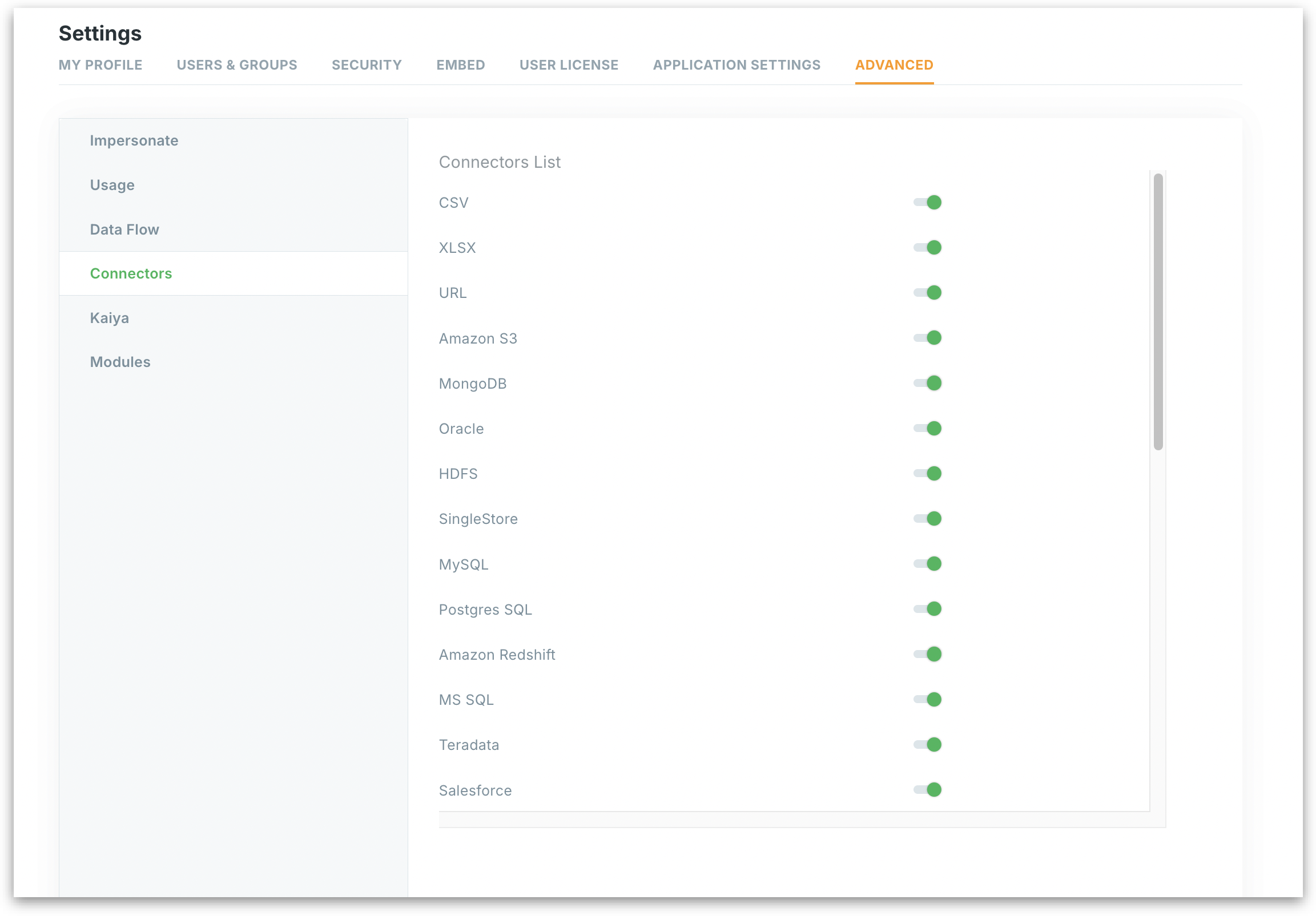
Under **Settings → Modules → Data → Connectors**, super users decide which data source connectors are offered across the workspace. Each connector has its own switch. When a connector is turned off, it no longer appears in the list of connectors on **Data → Connect**, so nobody can start a new connection with it.
### Connector groups
The connectors are grouped the same way as on **Data → Connect**:
| Group | Connectors |
| --------------------- | ----------------------------------------------------------------------------------------------------------- |
| File & web connectors | CSV, XLSX, JSON, XML, Unstructured Txt |
| Cloud Data Warehouses | Snowflake, Redshift, BigQuery, Azure Synapse, Teradata, Alloy DB |
| Relational Databases | MySQL, Postgres SQL, MS SQL, Oracle, EXASOL, SingleStore, CloudSQL MySQL, CloudSQL Postgres, CloudSQL MSSQL |
| Lakehouses | Databricks Delta Lake, Spark SQL, Hive, HDFS, Dremio |
| Object Stores | Amazon S3, Azure Blob Storage |
| APIs & Integrations | Salesforce, JDBC, URL, Looker |
| Others | FTP, MongoDB |
### Turn connectors on or off
1. Turn the switch next to each connector on or off.
2. Select **Save** at the top right.
**Cancel** puts every switch back the way it was saved. If you leave the page with unsaved changes, Tellius asks whether to keep editing or discard them.
{% hint style="success" %}
**Offer only what your teams use.** If your organization loads data only from Snowflake and Salesforce, turn the other connectors off. People then see a short, relevant list on **Data → Connect**, and data comes in only through the sources your data team supports. Turn a connector back on at any time to offer it again.
{% endhint %}
For how to set up each connection, see [Create new datasource](/tellius-6.4/data/create-new-datasource.md). Some connectors have extra settings for the whole workspace, such as the S3 staging area for Redshift. See [Connector Settings](/tellius-6.4/settings/connector-settings.md).
### Who can see this page
Only super users see **Connectors** in Settings. A custom role reaches it with **Manage system** under **Administration**. See [Custom roles](/tellius-6.4/settings/users-and-access/custom-roles.md).
### In releases before Tellius 6.4
This list was under **Settings → Advanced → Connectors**.
Enabling/disabling connectors
---
# Agent Instructions
This documentation is published with GitBook. GitBook is the documentation platform designed so that both humans and AI agents can read, navigate, and reason over technical content effectively. Learn more at gitbook.com.
## Querying This Documentation
If you need additional information that is not directly available in this page, you can query the documentation by asking a question.
Perform an HTTP GET request on the following URL with the `ask` and `goal` query parameters:
```
GET https://help.tellius.com/tellius-6.4/settings/connectors.md?ask=&goal=
```
`ask` is the immediate question: it should be specific, self-contained, and written in natural language.
`goal` is what the user is ultimately trying to achieve, the reason they need the answer. Sharing it helps GitBook give you a better, more relevant answer. A goal is most helpful when it describes the outcome the user wants rather than restating the question. For example, with `ask=how do I create an API token`, a goal like `automate deployments from our CI pipeline` lets GitBook tailor the answer to that use case.
The response will contain a direct answer to the question and relevant excerpts and sources from the documentation.
Use this mechanism when the answer is not explicitly present in the current page, you need clarification or additional context, or you want to retrieve related documentation sections.