
👁️Actions in View mode
Explore actions in View Mode in Tellius Vizpads—filter data, switch charts, export visuals, and analyze insights without editing the original dashboard.
This page walks through every action available in View mode: change views, adjust resolution, format charts, apply filters at every level, interact with individual charts, and share or export your work.
When you open a Vizpad from the Explore listing, it loads in View mode by default. View mode is designed for everyone who consumes a Vizpad: business users, executives, analysts reviewing someone else's work, and anyone who wants to slice and explore the data without permanently changing the underlying Vizpad.

You can interact with charts, apply filters, change formatting, switch resolutions, and save your work as a personal Custom View, but the original Vizpad created by the owner stays untouched unless you explicitly enter edit mode.
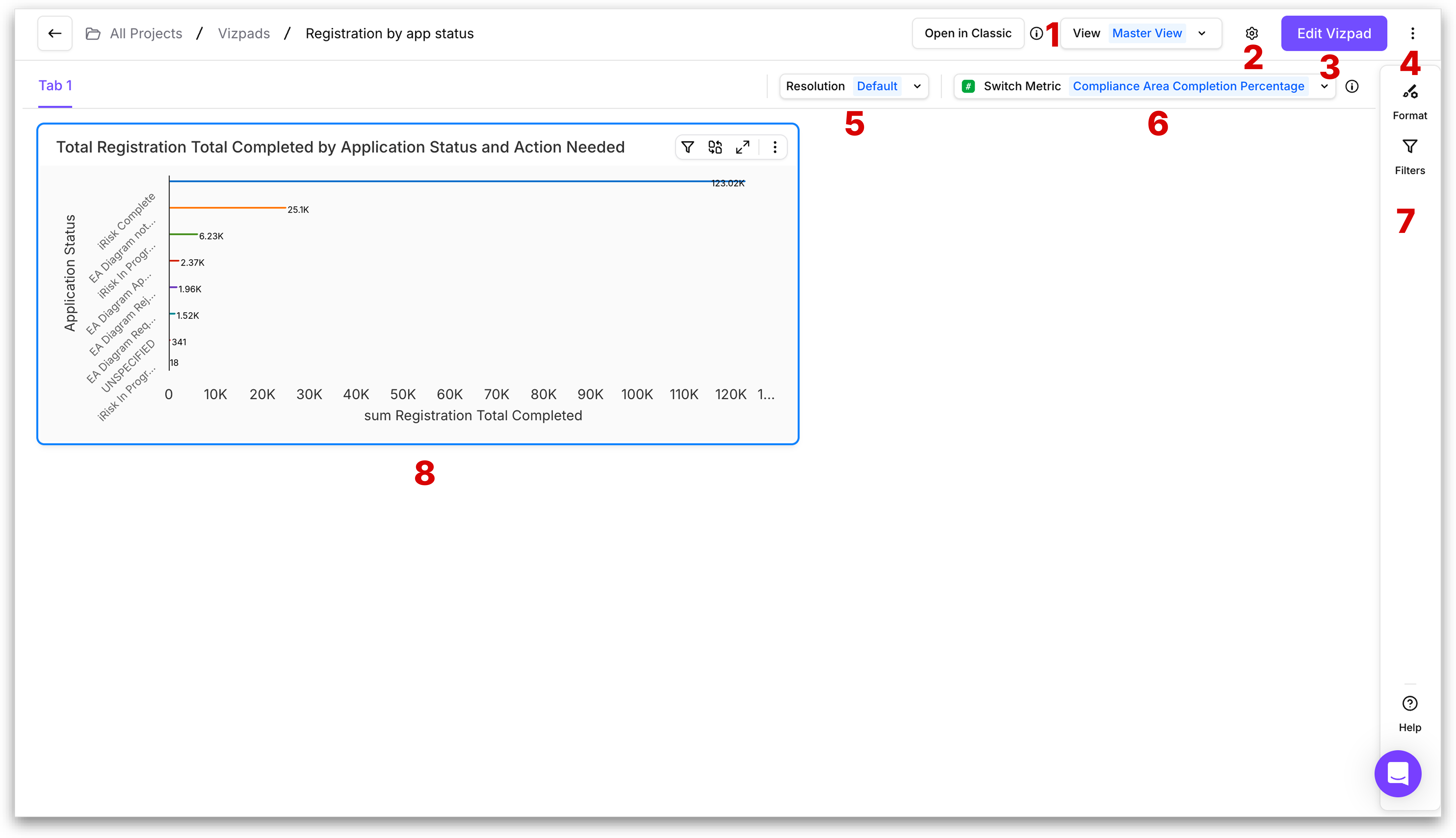
Open in Classic button opens the Vizpad in the classic (legacy) Vizpad experience.
Revert: Discards any unsaved changes you've made in the current session (filters, resolution, formatting tweaks) and restores the Vizpad to the state you opened it in. Revert appears only after you've made a change.

Save View: Saves the changes you made to the Vizpad as a new Custom View.
The above two buttons appear only after you've made a change in the current Vizpad.
View dropdown: Displays the list of available views. Switch between Master View (the default view defined by the Vizpad owner) and any Custom Views that have been saved.
A Custom View is a personal save state of a Vizpad. Any change you make in View mode can be persisted to a Custom View. The original Master View stays untouched, so the Vizpad owner's canonical version is always preserved.
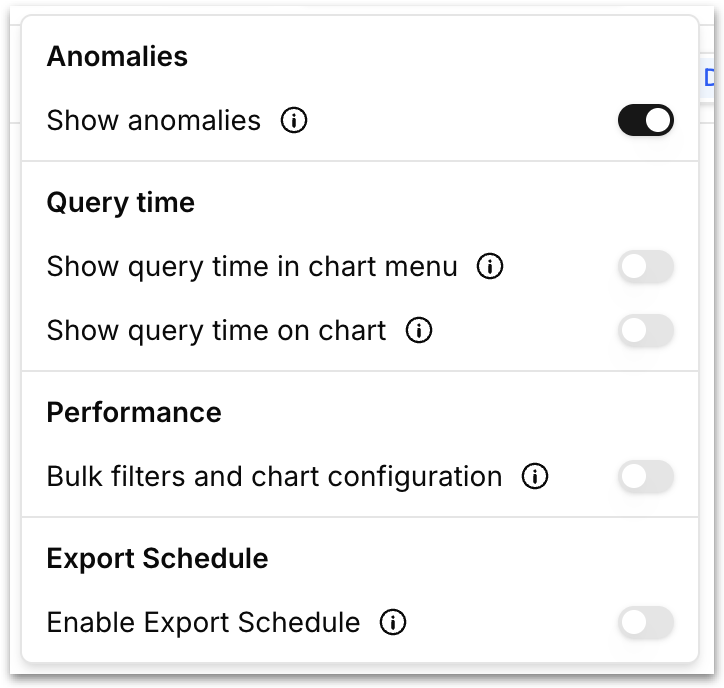
Settings gear: Opens the Vizpad-level settings panel.

Anomalies
Show anomalies: When enabled, Tellius highlights anomalous data points directly on the charts. Anomalies are detected by Tellius's built-in statistical models and surfaced inline so outliers stand out in the visualization.
Query time
Show query time in chart menu: When enabled, the load time for each chart is displayed inside that chart's three-dot menu under Time taken. This is helpful when you're investigating performance of each chart.
Show query time on chart: When enabled, the query time is shown directly on the chart header next to its title (for example, 130ms) so you can scan performance across the whole Vizpad at a glance.
Performance
Bulk filters and chart configuration: Controls when filter and configuration changes get pushed to the charts on the canvas. The behavior changes meaningfully depending on whether the toggle is on or off:
When disabled: Every change you make is applied to the Vizpad instantly, and Tellius re-runs the affected queries immediately after each change.
When enabled: Tellius batches your changes and waits for you to click Apply before pushing them to the canvas. Until you click Apply, you can stack multiple filter additions, formatting tweaks, and configuration changes without triggering a single query. When you click Apply, all queued changes are committed and the affected charts re-render in one pass. Click Revert at any time before applying to discard the queued changes and return to the last committed state.
Use bulk mode on dense Vizpads with many charts. Disable it for small Vizpads and quick edits.

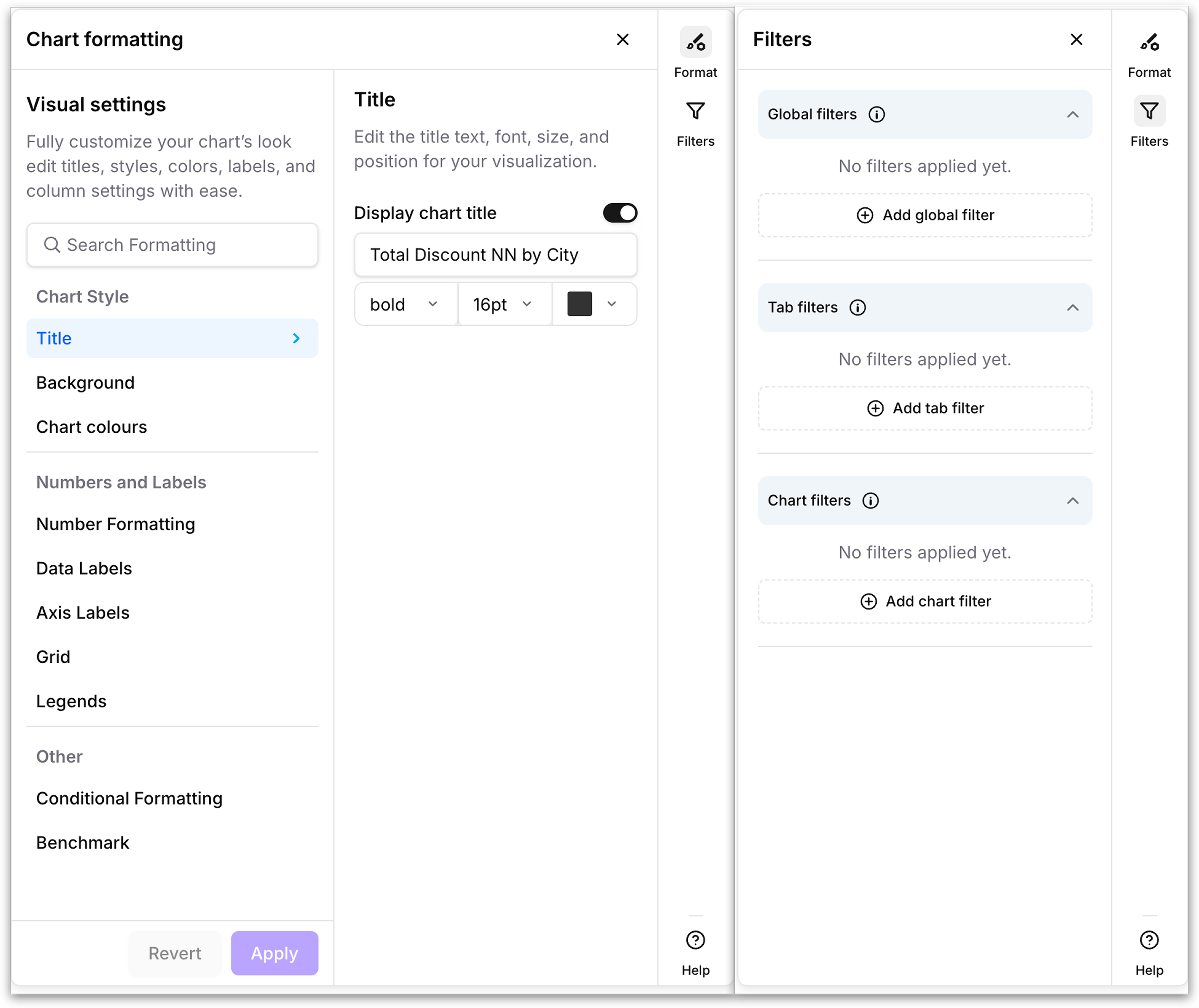
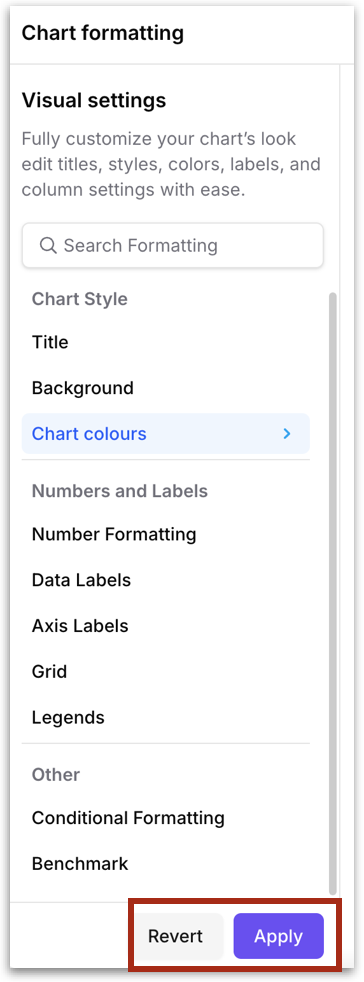
The Apply and Revert buttons sit at the bottom of the panel and only become active once you've made a change.
Apply commits every pending formatting change to the chart in one go, so you can experiment with multiple settings and push them all at once.
Revert discards every pending change and restores the chart to the formatting state it was in when you opened the panel.
Export Schedule
Enable Export Schedule: Turns on scheduled exports for this Vizpad. Once enabled, you can configure a recurring export (daily, weekly, monthly) that delivers a snapshot of the Vizpad to specified recipients on a fixed cadence.
Edit Vizpad: Switches to edit mode, where you can add charts, change configurations, and save changes back to the original Vizpad. This button is only enabled if you have edit permission on the Vizpad.
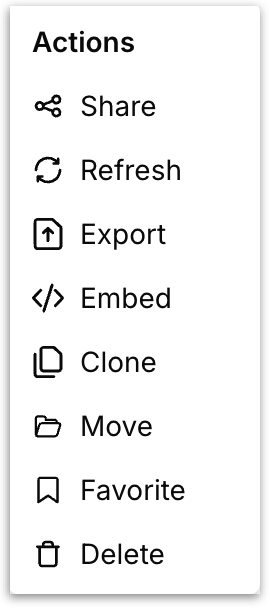
Three-dot actions menu: The three-dot menu in the top right of the top bar exposes the full set of Vizpad-level actions. For more details, check out this section.

The actions visible in this menu depend on your role and how the Vizpad was shared with you. If you opened a Vizpad with View permission only, certain actions like Move and Delete will be hidden.
Share: Open the Share Vizpad dialog to grant another user, email address, or user group access to the Vizpad with either Can view or Can edit permission. Admins and super users can also pin a Vizpad to a group from this dialog so it appears in every group member's Pinned tab.
Refresh: Triggers a fresh query against the underlying data so the Vizpad reflects the latest values.
Export: Downloads the entire Vizpad as a .zip file.
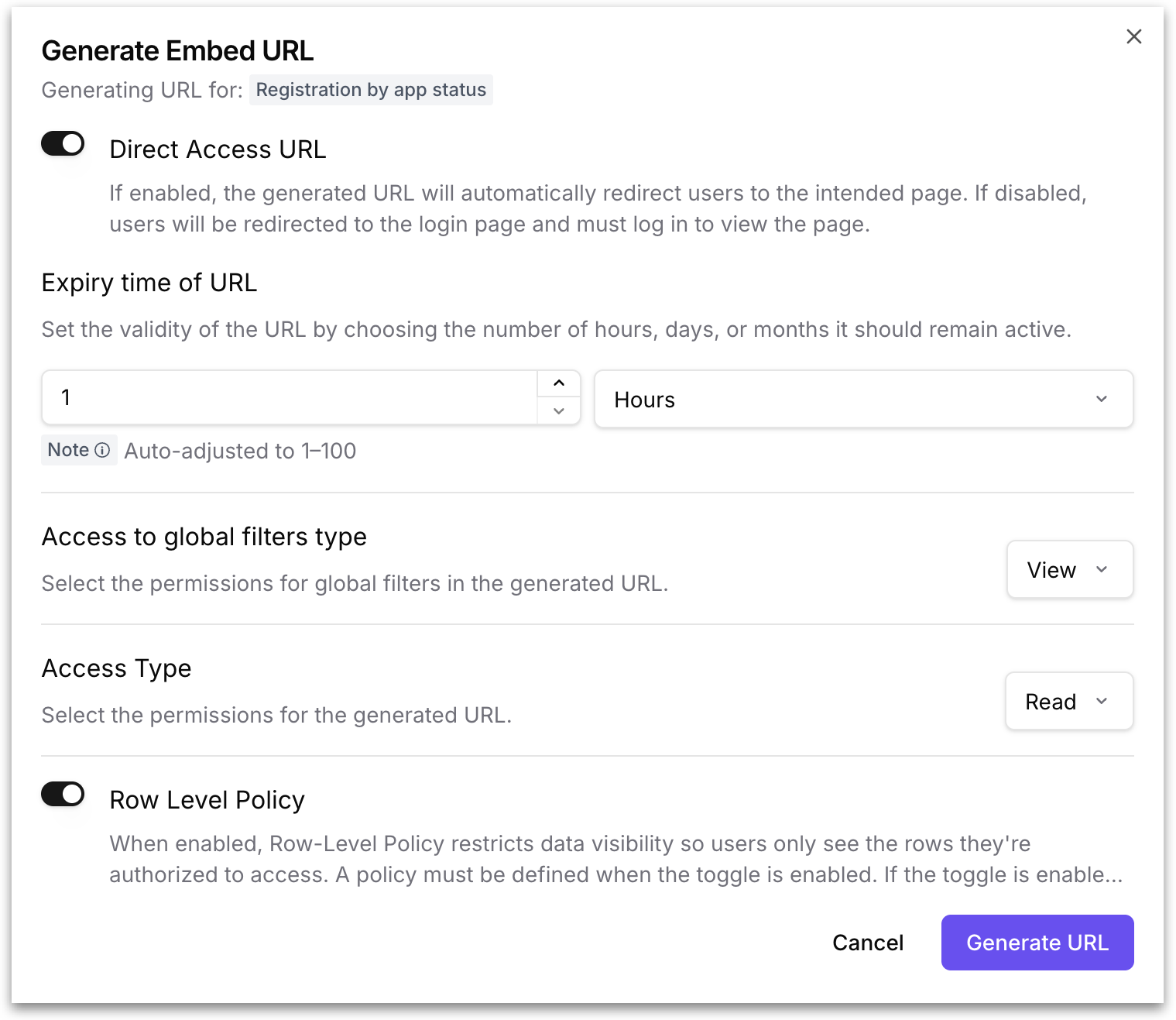
Embed: Opens the Generate Embed URL dialog, which builds a sharable URL that renders the Vizpad as a standalone page.
Direct Access URL: When enabled, the URL takes recipients straight to the Vizpad. When disabled, recipients land on the Tellius login page first and must authenticate before the Vizpad renders.
Expiry time of URL: Set how long the URL stays valid. Pick a number and a unit (Hours, Days, or Months). Tellius auto-clamps the value to a 1–100 range. After the URL expires, the link will become invalid.
Access to global filters type: Controls whether recipients can change the global filters on the embedded Vizpad. Choose View to lock filters to their current state, or Edit to let recipients modify them. Hide option hides the global filters.
Access Type: Controls overall permission on the embedded Vizpad. Choose Read (view-only) and Write (edit access) as required.
Row Level Policy: When enabled, the embedded Vizpad respects the row-level security policies attached to the underlying dataset, so recipients only see the rows they're authorized to access. A row-level policy must already be defined on the dataset for this toggle to take effect.
Click Generate URL to create the link. Tellius will display the generated URL with options to copy it or open it in a new tab.

Clone: Creates a duplicate of the Vizpad in your account. The clone is fully editable and independent of the original.
Move: Moves the Vizpad to a different Project folder.
Favorite: Mark or unmark the Vizpad as a favorite. Favorites surface under the Favorites tab on the Explore listing.
Delete: Permanently deletes the Vizpad after a confirmation prompt. Deleted Vizpads cannot be recovered.
Resolution: This dropdown applies a global time grain to every time-based chart in the Vizpad.
Default
Each chart renders at the resolution defined by its owner.
Hourly
All time-based charts roll up by hour.
Daily
All time-based charts roll up by day.
Weekly
All time-based charts roll up by week.
Monthly
All time-based charts roll up by month.
Quarterly
All time-based charts roll up by quarter.
Yearly
All time-based charts roll up by year.
This is useful when you want to compare a daily-trending chart and a monthly-trending chart on the same time scale without opening each one individually. Charts whose data does not contain a time dimension are unaffected.
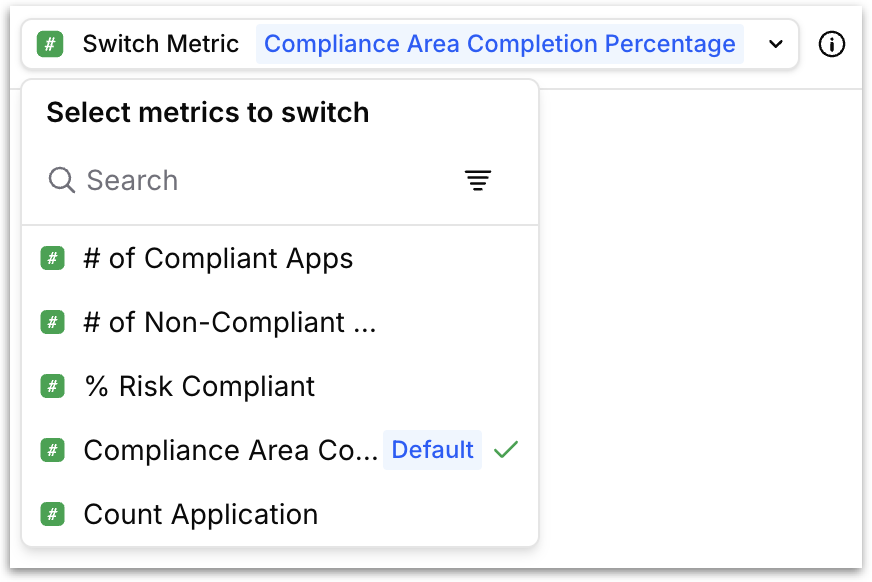
Switch Metric: Switch Metric lets you replace a chart’s current measure with another measure. Click on Switch Metric to see the list of available measures (this can be configured in Vizpad Edit mode). The currently used metric is marked with a Default tag.

When you pick a new metric, every chart that uses the original measure automatically re-renders with the new one.
Filters, dimensions, formatting, and chart types are all preserved; only the measure changes.
This is the fastest way to compare the same Vizpad across different KPIs (for example, switching from Compliance Area Completion Percentage to % Risk Compliant across a dozen charts at once).
The list of metrics that appear here is configured by the Vizpad owner in edit mode. If a metric you expect isn't in the list, please check with the owner/admin to add it to the switchable metrics set.
Metric changes made via Switch Metric are not saved to a Custom View. They apply for the duration of your session and reset when you close the Vizpad.
Chart-level actions: Hovering over any chart on the canvas reveals a row of icons in the chart's top-right corner.

Filter: Click the funnel icon to add a chart-level filter that applies only to this single chart. This is scoped to one chart. Use it for quick what-if exploration without touching the chart's underlying configuration. Once a filter is added, clicking on the Filter icon again will show/hide the applied filters. The chart re-renders accordingly. To add more filter(s), click on the filter icon and click on + at the end of the filter pills.
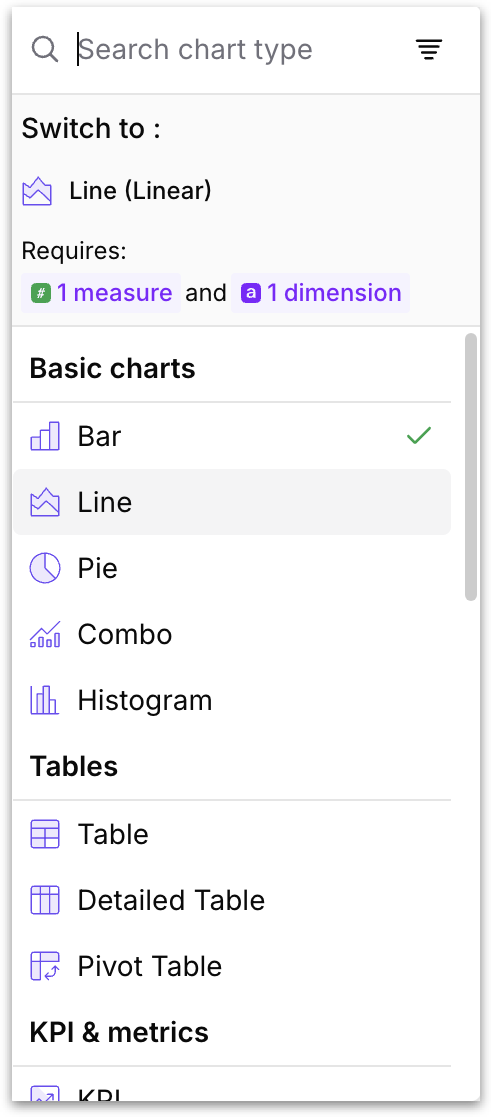
Switch Chart: Click this icon to change the chart type. Tellius shows you every available chart type and automatically greys out any that aren't compatible with the chart's current measures and dimensions. When you pick a new type, all current values, filters, and formatting are preserved and re-rendered, so a bar chart with a global filter applied becomes a line chart with the same filter applied.

Expand / Collapse: Click the diagonal-arrows icon to enlarge the chart to fill the canvas. Click it again (or close the expanded view) to collapse the chart back to its original tile size.
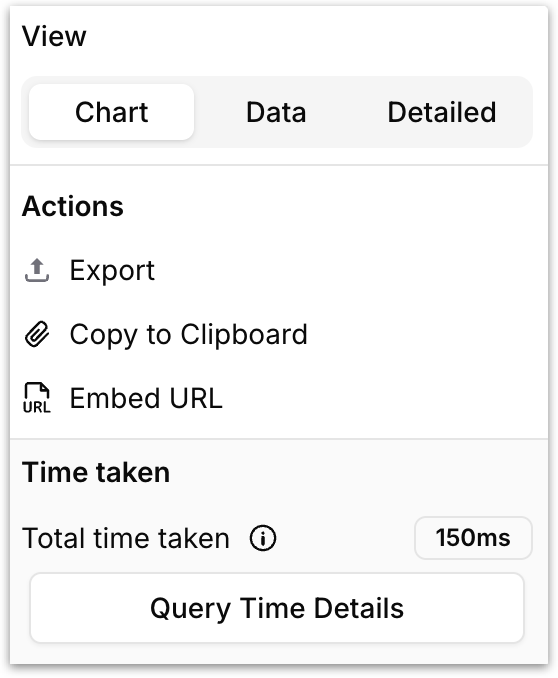
Three-dot chart menu: Clicking the three-dot menu on any chart opens a panel with three groups of actions: View, Actions, and Time taken.

a. View: Switch how the chart's data is rendered:
Chart: The default visual representation (bar, line, pie, etc.).
Data: A simple tabular view of the chart's underlying data.
Detailed: A richer tabular view with all columns from the underlying query, including any columns that don't appear on the visual chart. Useful when you want to see the row-level data behind a summary visualization.
b. Actions
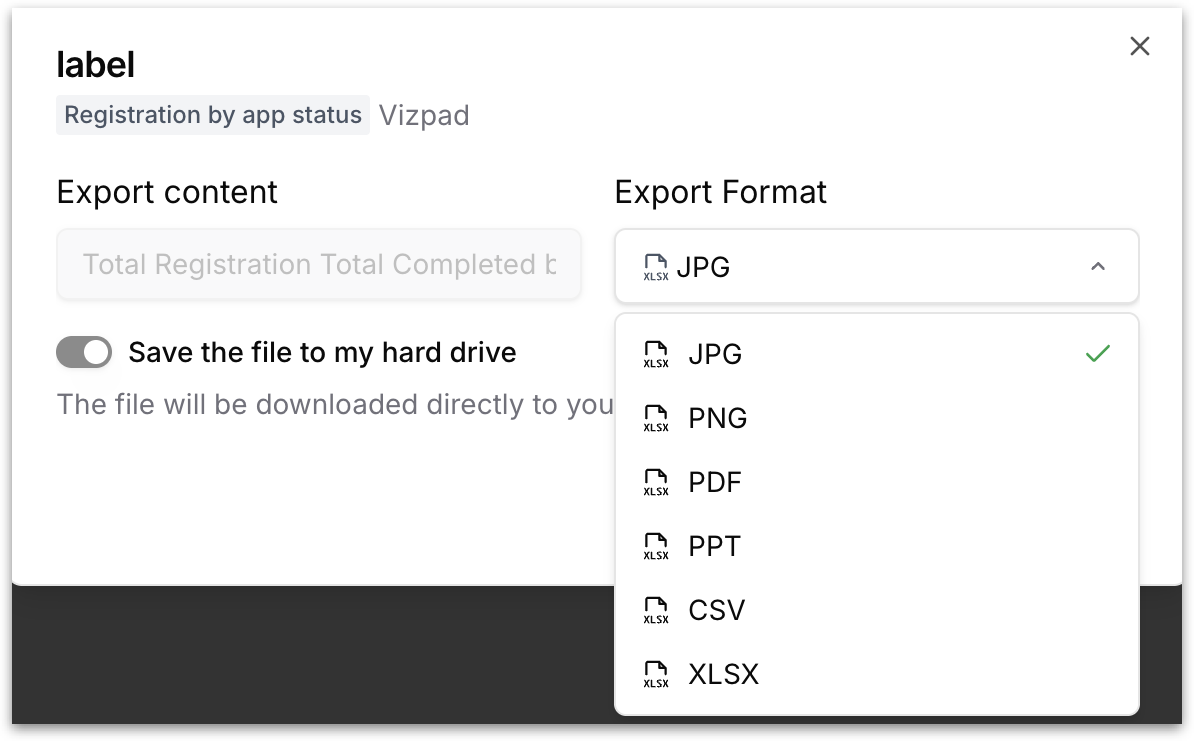
Export: Downloads the current chart in your choice of format (JPG, PNG, PDF, CSV, XLSX or PPT). Tabular views can be exported as CSV; visual charts can be exported as image or document formats. Check out this page for more details.

Copy to Clipboard: Saves the chart and all of its current settings to your Tellius clipboard. You can then paste it into the same Vizpad (in another tab) or into a different Vizpad (in edit mode), with all of its configuration intact. This is the fastest way to reuse a chart you've already built.
Embed URL: Generates an embed URL for this single chart. The dialog matches the Vizpad-level Embed dialog, but the resulting URL renders only the one chart as a standalone element. Use this when you want to share a specific visualization without exposing the entire Vizpad.
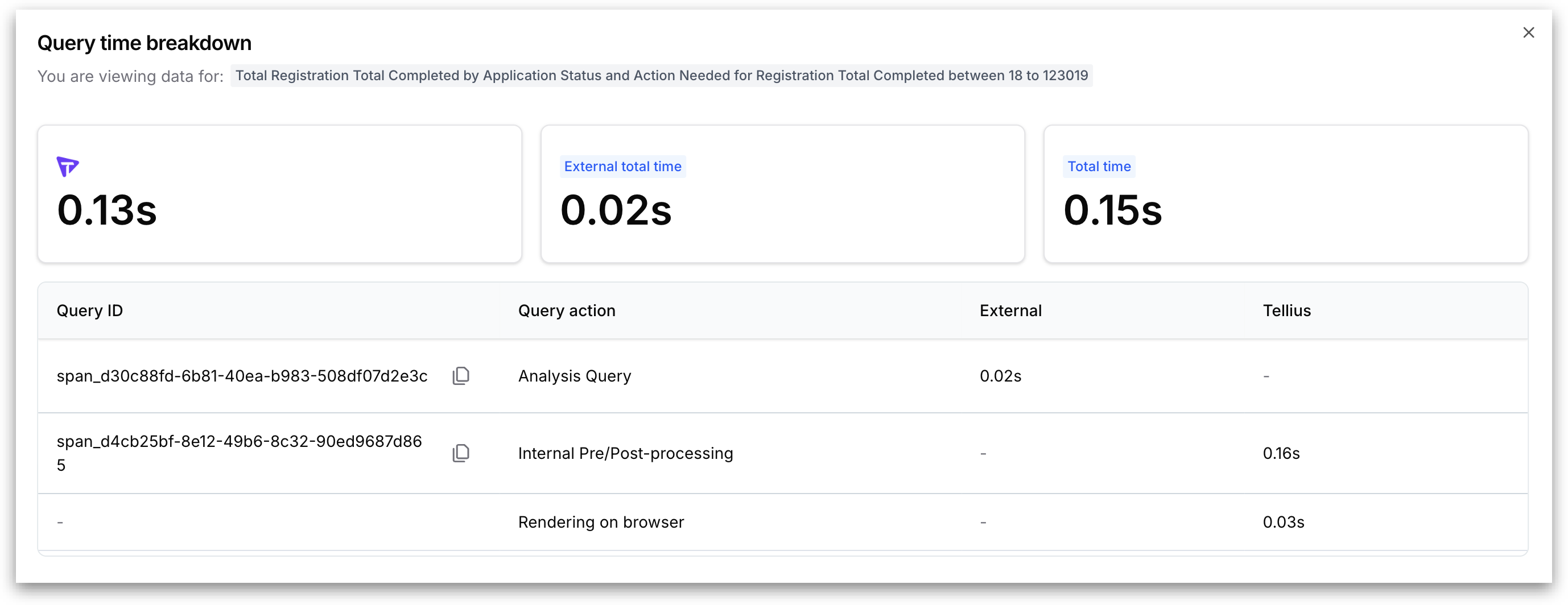
c. Time taken
Total time taken: Shows the most recent load time for this chart
Query Time Details: Click to open a full breakdown of where time was spent. Displays Tellius engine time, external engine time, network, and rendering. Use this when you're investigating the performance of a chart.

The query time options in the chart menu are gated by the Show query time in chart menu toggle in Vizpad settings. If you don't see them, enable that toggle from the gear icon in the top bar.
Help
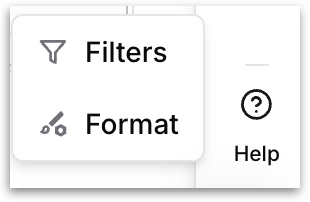
The Help icon sits at the bottom of the right pane. Clicking it launches a guided tour of the view mode interface: a step-by-step tooltip walkthrough that highlights each section in the right pane.

The tour walks through each section, spotlighting each icon and displaying a tooltip that briefly explains what the panel does.
Each tooltip has two options: click NEXT to advance to the next panel in the tour, or click Skip to dismiss the tour entirely. The tour is available on demand; click Help any time you need a quick refresher without leaving the canvas.
Was this helpful?